
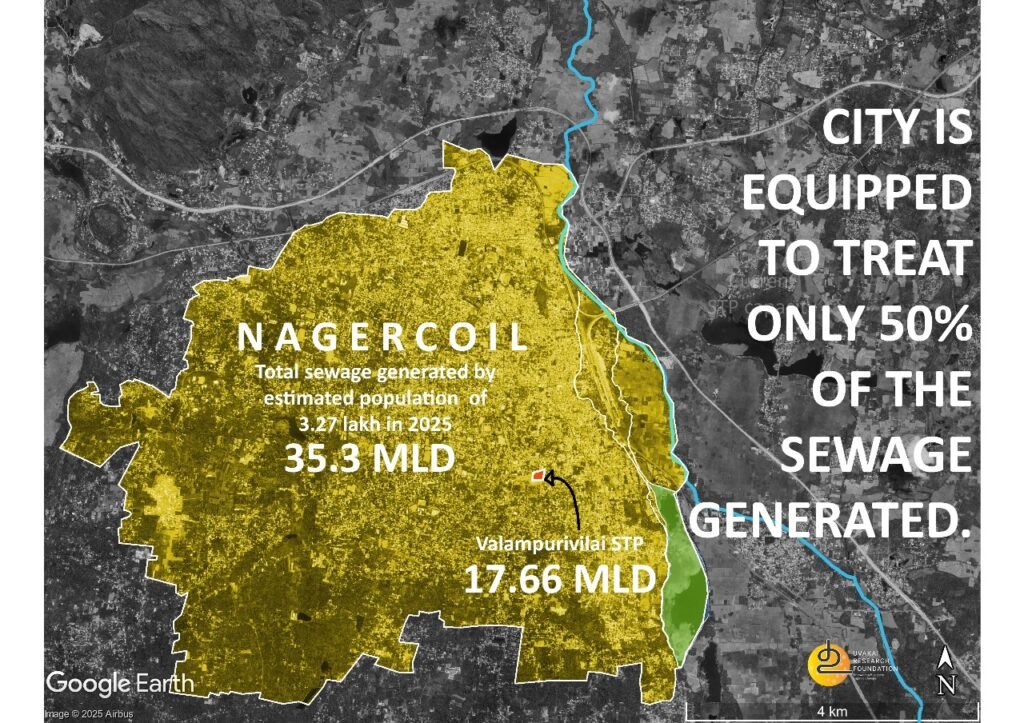
The Suchindram–Theroor Wetland Complex, a 94-hectare Ramsar-listed ecosystem in Kanniyakumari District, is a cornerstone of southern Tamil Nadu’s hydrological balance. As part of the Pazhayar River system, this wetland sustains flood control, irrigation, groundwater recharge, and rich biodiversity. Yet, the unchecked flow of untreated sewage from Nagercoil has turned a vital ecosystem into a pollution sink.[1]
Hydrological and Urban Linkage
Two canals sustain this wetland — the Parakkayan Canal, flowing from the Sabari Anicut, and the Suchindram Canal, sourced from the Kumari Anicut. The Parakkayan Canal is critical but compromised, as it intercepts urban sewage from Nagercoil’s core before merging into Suchindram Lake. The inflows bring organic waste, detergents, and pathogens, destabilizing aquatic ecosystems and accelerating eutrophication.[2][3]
The Nagercoil Underground Drainage (UGD) Project, built at a cost of ₹129 crore, includes:
- Pipe network: 115,923 metres and 4,667 manholes
- Pumping station: At Vadiveeswaram
- STP: Located at Valampurivilai (17.66 MLD, using Extended Aeration Sludge Process)
Although completed, the STP remains uncommissioned as of 2025. With a population now nearing 3.27 lakh, the city generates around 35.3 MLD of sewage, leaving half untreated. The untreated water reaches the Suchindram Wetland via open drains in the Parakkayan Canal, deteriorating water quality and violating the Wetlands (Conservation and Management) Rules, 2017.[3][4]
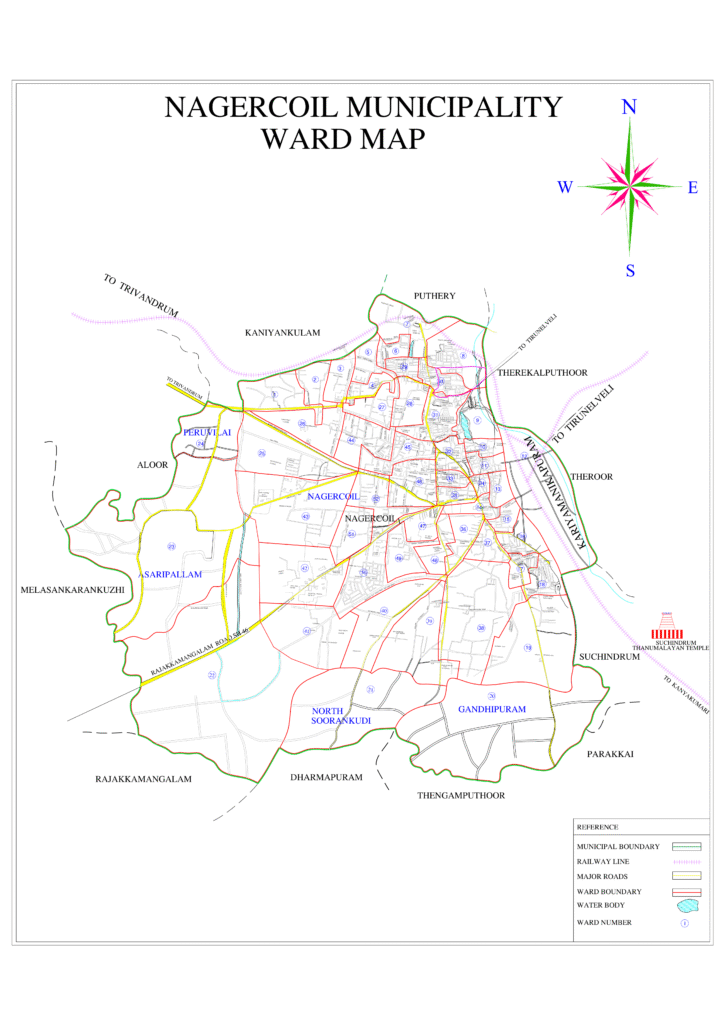
According to the 2025 municipal data, Nagercoil comprises 52 wards with populations ranging from 4,000 to 6,000 people each. This population distribution presents an untapped opportunity for modular and decentralized wastewater management.[5]
In the case of Nagercoil:
- Treating sewage at the ward level is logistically simpler and economically viable.
- A 4,000–6,000 person ward generates approximately 0.45–0.65 MLD of sewage (based on 108 L per capita/day), allowing installation of micro-modular STPs at local collection points.
- Addressing sewage at a micro or ward level creates multiple containment nodes, significantly reducing the load on the main STP.
Handling sewage for 350,000 people in a single centralized system demands extensive pipeline networks, higher pumping energy, and greater land area — making it resource-consuming and harder to maintain. In contrast, managing 6,000 people per unit under modular ward-level networks is operationally more sustainable.
Even plot-level sewage systems, where household tanks integrate new bacterial inoculant technology, can reduce organic load before reaching decentralized ward-level systems — making total treatment much more feasible and affordable.
| Parameter | Modular STP | Conventional STP |
| Construction Time | 2–3 months (prefabricated) | 6–12 months (civil-intensive) |
| Cost per MLD | ₹1–1.5 crore | ₹2–2.5 crore |
| Land Requirement | 30–40% lower | High (large basins, clarifiers) |
| Scalability | Modular units added as needed | Requires major extension work |
| Operation & Manpower | Automated, minimal staff | Manual monitoring, skilled labour-heavy |
| Energy Consumption | Low due to modern aeration | High due to blower-dependent processes |
| Recycling Capability | High; output fit for reuse (98% BOD/COD removal) | Moderate |
| Sustainability | Low sludge production | High sludge and odour load |
| Deployment Scope for Nagercoil | Can be distributed across 52 wards | Single location—complex expansion |
Why Nagercoil Needs a Modular Approach
- Micro-Level Viability: Managing ward-wise treatment aligns with the city’s compact ward structure and population densities.
- Land Optimization: Modular STPs can be installed in small urban pockets near canals or parks, minimizing civil work.
- Phased Expansion: Instead of waiting for full-scale commissioning, smaller zones can begin functioning within two months, progressively expanding citywide.
- Sewage Source Reduction: Encouraging plot-level bacterial treatment units in residential and commercial properties reduces the organic load at the collection stage.
- Wetland Protection: Immediate reduction of untreated discharge helps restore Suchindram Lake’s ecological balance and supports Ramsar conservation objectives.
The degradation of the Suchindram–Theroor Wetland Complex reveals a pattern familiar across India’s mid-sized cities — infrastructure struggles to keep pace with urbanization.
For Nagercoil, solving this crisis requires a multi-tiered sewage management strategy that combines:
- Rapid commissioning of the Valampurivilai STP
- Deployment of modular ward-level micro STPs across 52 wards
- Encouragement of plot-level bacterial tank systems to treat sewage at the source
By treating waste nearest to its origin, Nagercoil can transform a chronic environmental hazard into a circular, sustainable sanitation model. In doing so, it would not only protect the Suchindram Wetland Complex but also establish a replicable model for urban wastewater resilience in ecologically sensitive districts.
- https://tnswa.tn.gov.in/pdf/brief_document/Suchindram Theroor Wetland Complex.pdf
- https://https://www.sciencedirect.com/science/article/abs/pii/S2215153224001144
- https://vigyanvarta.in/adminpanel/upload_doc/VV_0625_18.pdf
- https://cms.tn.gov.in/cms_migrated/document/docfiles/forests_e_pn_2024_25.pdf
- https://www.census2011.co.in/data/town/803927-nagercoil-tamil-nadu.html
- https://www.tnurbantree.tn.gov.in/nagercoil/wp-content/uploads/sites/36/2019/09/City-Sanitation-Plan-DPR.pdf
- https://en.wikipedia.org/wiki/Nagercoil_Municipal_Corporation
- https://tcp.tn.gov.in/storage/app/document/MtgYfPS0CjBnYyvRXRiKUQAdQX51DFMQn79rTAc1.pdf
- https://censusindia.gov.in/nada/index.php/catalog/6820
- https://en.wikipedia.org/wiki/Nagercoil
- https://kanniyakumari.nic.in
- https://www.censusindia.co.in/towns/nagercoil-population-kanniyakumari-tamil-nadu-803927
- https://www.census2011.co.in/census/city/490-nagercoil.html