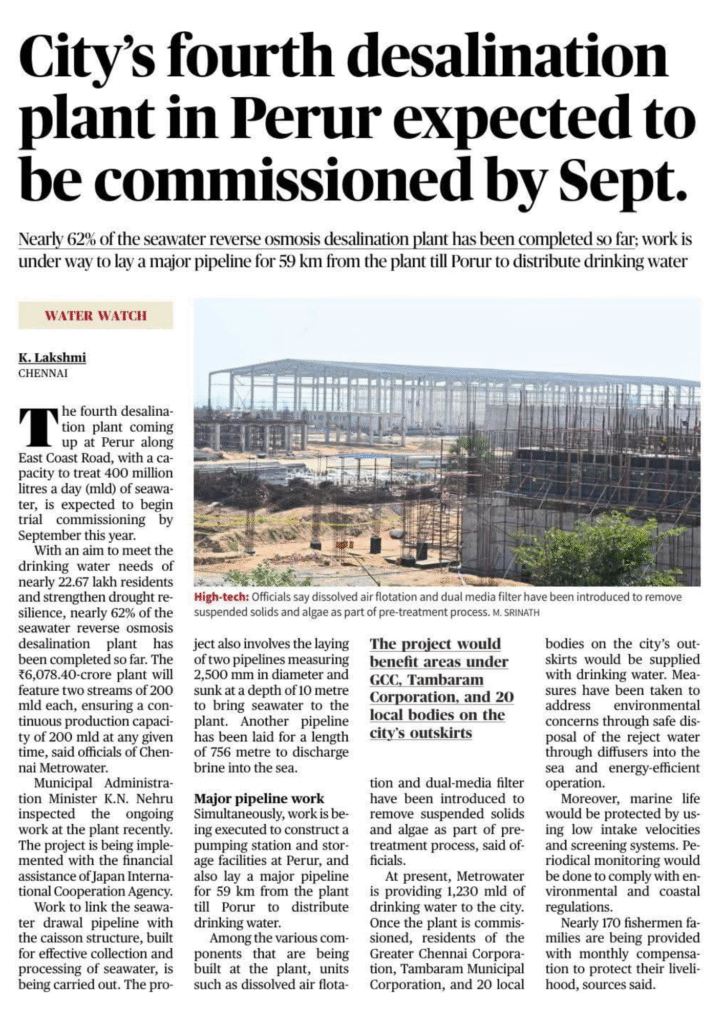
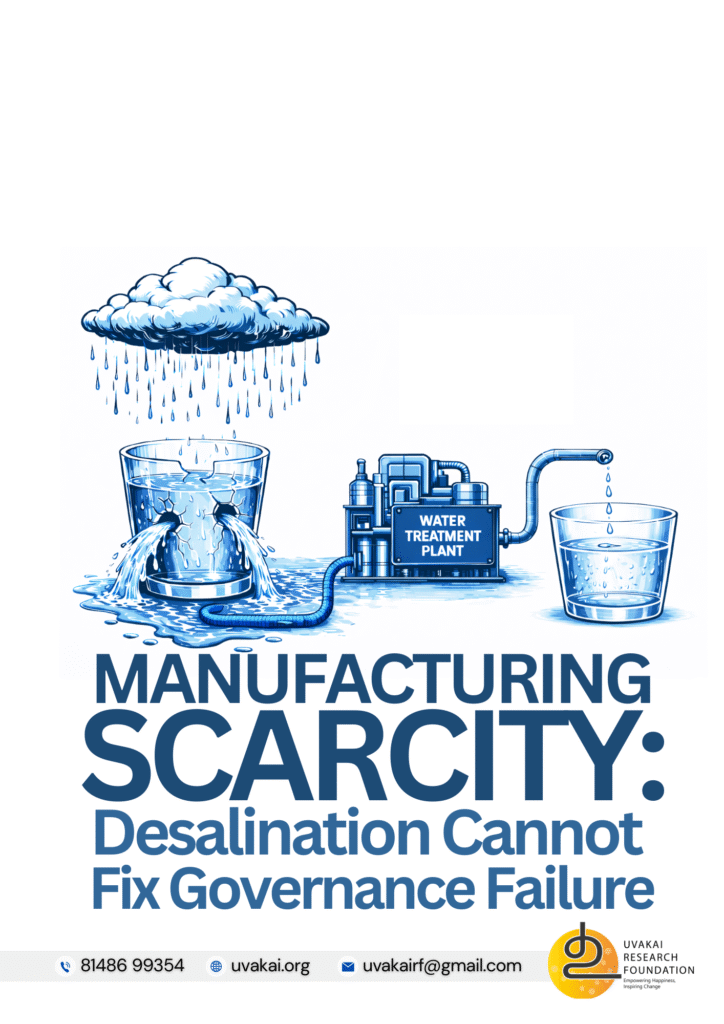
The announcement of the 400 MLD desalination plant at Perur, intended to supply Tambaram Corporation and the southern corridor of Chennai, is being positioned as a major step toward drought-proofing the city. With a 59 km transmission pipeline under construction and significant capital investment already committed, the project reflects the State’s continued reliance on large-scale, energy-intensive infrastructure.
But before celebrating new supply creation, we must pause and ask a fundamental question:
Is Chennai truly running out of water – or are we running out of storage and governance?
The Governance Failure
Water management in Tamil Nadu is institutionally fragmented.
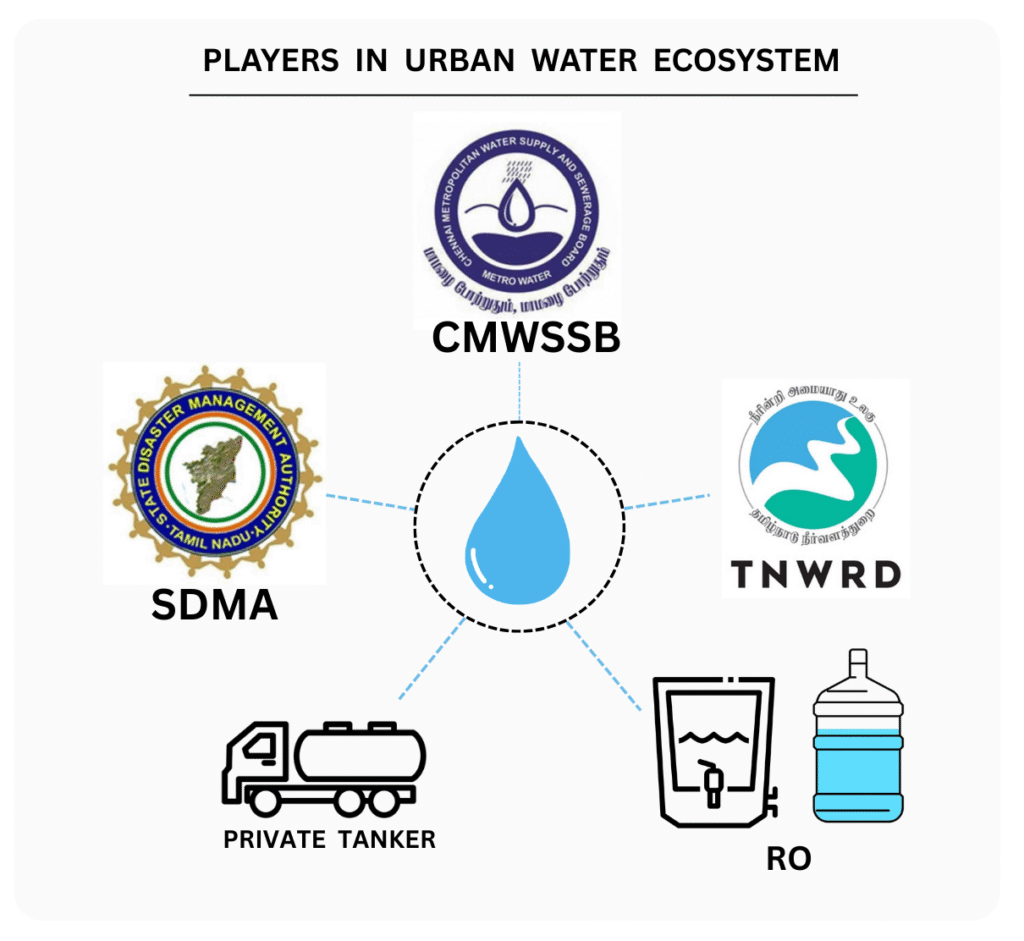
- The Water Resources Department (WRD) maintains lakes, tanks, and surface water bodies.
- The Chennai Metropolitan Water Supply and Sewerage Board (CMWSSB / Metro Water) is responsible for year-round drinking water supply and sewage management.
- The Tamil Nadu State Disaster Management Authority (TNSDMA) focuses on flood mitigation.
In principle, these departments should function in an integrated manner to build a healthy urban water cycle. In practice, they operate in silos.
When storage structures are poorly maintained or inadequately managed by the WRD, the storage capacity of lakes, tanks, and wetlands declines. During intense monsoon rainfall, instead of being retained, water quickly turns into flooding. Disaster response then prioritizes rapid drainage — pushing water to the sea as quickly as possible. Once 80–90% of monsoon runoff is discharged without retention, summer scarcity becomes inevitable. Metro Water then faces pressure to supply drinking water during dry months. Without coordinated basin-level planning with the WRD or Disaster Management authorities, supply teams pursue independent solutions — most notably desalination plants.
Adding to this, another disconnect exists within Metro Water itself. The water supply division focuses on creating new sources — such as desalination plants — which are energy-intensive and capital-heavy. Meanwhile, the sewage division expands its own infrastructure by constructing large pumping stations and centralized sewage treatment plants — again energy- and cost-intensive. If supply expansion and sewage treatment planning were structurally integrated, treated wastewater could directly augment supply, reduce freshwater demand, and lower dependence on desalination.
However, the governance gap extends beyond government departments. There are two powerful private players shaping the urban water economy:
- Household RO Systems and Water Can Industry
A strong belief system has taken root among citizens. Even when treated water supplied by Metro Water may require only basic boiling to make it potable, many households prefer to install Reverse Osmosis (RO) treatment systems or rely exclusively on packaged RO water cans for drinking. This indicates a deeper issue — a lack of public trust in government-supplied water.
As a result, private RO system manufacturers and packaged water suppliers have become embedded in the domestic water chain, adding cost, energy use, and additional wastewater generation at the household level.
5.Private Tanker Lorries
During summer months, the role of private tanker operators becomes inevitable. In many areas, the entire supply chain is effectively managed by tanker lorries. They determine availability, routes, extraction sources, and, crucially, the price of water. The cost of water is often dictated by market dynamics rather than regulatory oversight. This creates a parallel, privatized water economy operating alongside the public system.
At present, the urban water loop does not close.
Monsoon water is drained instead of stored.
Stored water is insufficiently managed.
Treated wastewater is not fully reintegrated into supply.
Public trust is weak.
Private intermediaries fill the gaps.
What we are witnessing is not a hydrological failure — rainfall is adequate, basins exist, storage structures exist, and treatment technologies exist. It is fundamentally a governance failure.
The Real Cost of Desalination
Desalination is often presented as a technologically advanced solution. However, its economics tell a more complex story.
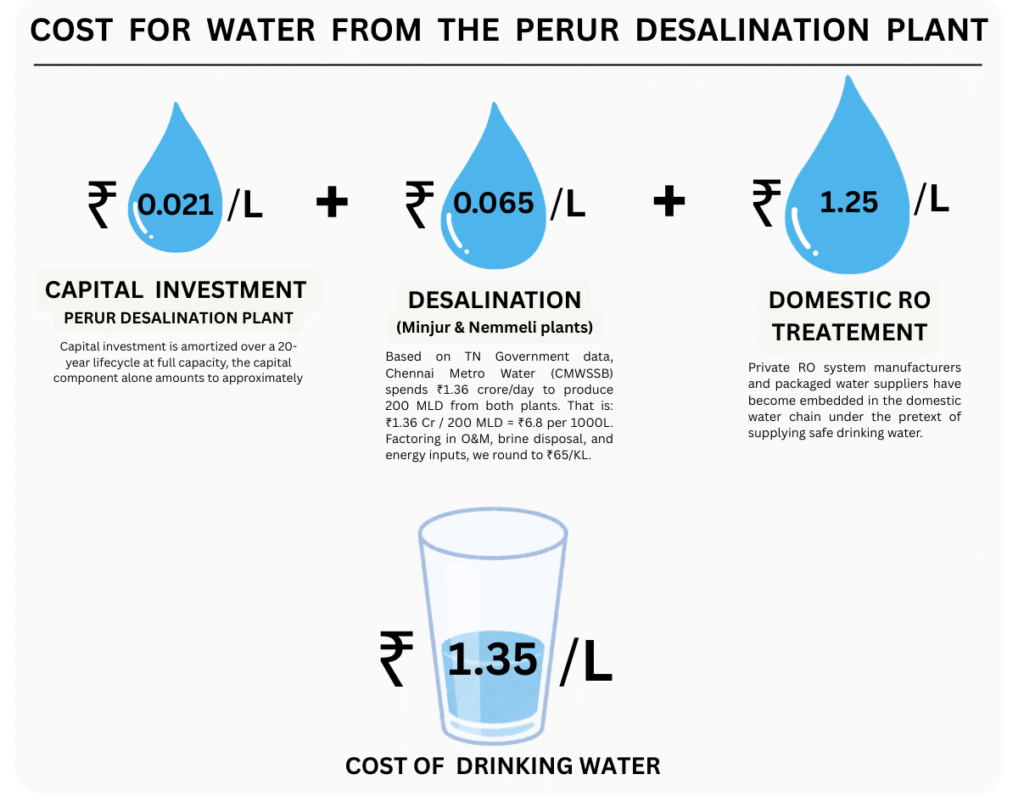
The recently announced desalination project comprises two 200 MLD plants (total 400 MLD) with an estimated capital cost of approximately ₹6,078 crore. This translates to roughly ₹15.19 crore per MLD of installed capacity — or about ₹1.52 lakh per kilolitre of daily production capacity. If amortized over a 20-year lifecycle at full capacity, the capital component alone amounts to approximately ₹21 per kilolitre. When combined with operational costs, estimated at around ₹65 per kilolitre, the total lifecycle cost is approximately ₹85–90 per kilolitre, potentially exceeding ₹100 per kilolitre when financing and escalation factors are included.
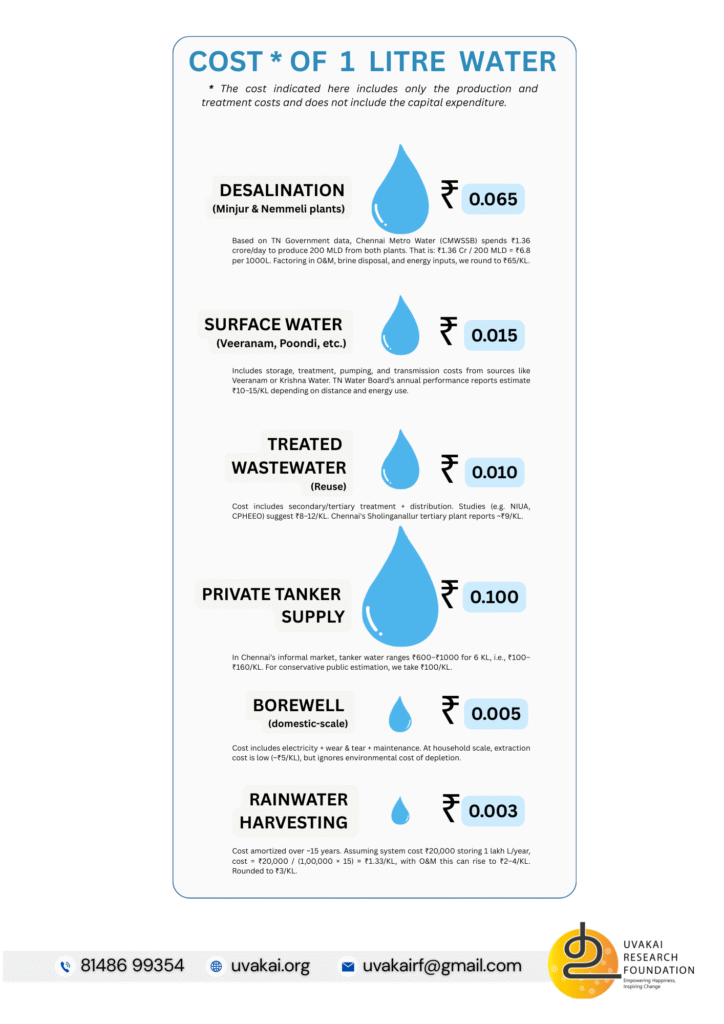
By comparing only, the production and treatment cost without including the capital investments:
- Desalinated water cost roughly ₹65 per KL
- Surface water supply costs roughly ₹10–15 per KL.
- Treated wastewater reuse costs approximately ₹8–12 per KL.
- Rainwater harvesting and groundwater extraction cost as low as ₹3–5 per KL.
- Private tanker water, though informal and unregulated, averages around ₹100 per KL.
Desalination is therefore four to six times more expensive than most local alternatives – and, over its lifecycle, may approach the cost of private tanker supply. The technology by itself, requires continuous high-energy input, marine intake and brine discharge systems, long-distance pumping, and permanent operational expenditure. Infrastructure created to solve one problem risks becoming a long-term financial burden.
Desalination is often presented as a technologically advanced solution. However, its economics tell a more complex story.
The recently announced desalination project comprises two 200 MLD plants (total 400 MLD) with an estimated capital cost of approximately ₹6,078 crore. This translates to roughly ₹15.19 crore per MLD of installed capacity — or about ₹1.52 lakh per kilolitre of daily production capacity. If amortized over a 20-year lifecycle at full capacity, the capital component alone amounts to approximately ₹21 per kilolitre. When combined with operational costs, estimated at around ₹65 per kilolitre, the total lifecycle cost is approximately ₹85–90 per kilolitre, potentially exceeding ₹100 per kilolitre when financing and escalation factors are included.
By comparing only, the production and treatment cost without including the capital investments:
- Desalinated water cost roughly ₹65 per KL
- Surface water supply costs roughly ₹10–15 per KL.
- Treated wastewater reuse costs approximately ₹8–12 per KL.
- Rainwater harvesting and groundwater extraction cost as low as ₹3–5 per KL.
- Private tanker water, though informal and unregulated, averages around ₹100 per KL.
Desalination is therefore four to six times more expensive than most local alternatives – and, over its lifecycle, may approach the cost of private tanker supply. The technology by itself, requires continuous high-energy input, marine intake and brine discharge systems, long-distance pumping, and permanent operational expenditure. Infrastructure created to solve one problem risks becoming a long-term financial burden.
The Untapped Resource: Wastewater and Local Catchments
Over the past decade, Chennai’s water story has been framed around crisis – Day Zero, tanker dependence, borewell failure, and the expansion of desalination. This scarcity narrative has increasingly justified large, capital-intensive infrastructure. But basin-level hydrology in South Chennai – particularly the Pallikaranai catchment – tells a different story.
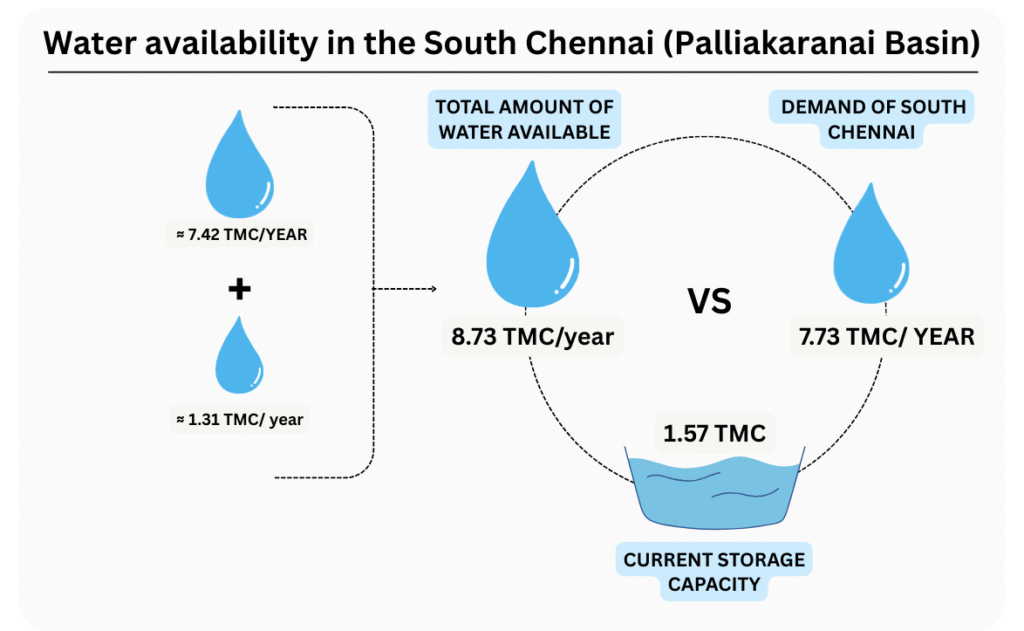
The region receives about 1200 mm of annual rainfall, generating roughly 7.42 TMC of runoff each year. Most of this rainfall occurs within just 4-5 months during the Southwest and Northeast monsoons, meaning the bulk of annual water is produced in a short seasonal window.
The real challenge, therefore, is storage – not supply.
If even 20% of treated wastewater reuse is implemented (The Atal Mission for Rejuvenation and Urban Transformation (AMRUT) 2.0), total annual water availability rises to 8.73 TMC, while South Chennai’s annual demand is about 7.73 TMC. In simple terms, the basin generates more water annually than it consumes. Yet the region has only 1.57 TMC of storage capacity, far too little to capture monsoon surpluses for use during dry months.
Additionally, South Chennai generates approximately 540 MLD of sewage daily, yet treatment infrastructure handles only about 144 MLD. Nearly 400 MLD remains untreated, often entering lakes and wetlands. If even 20% of total wastewater were treated and reused, over 100 MLD of freshwater demand could be offset – at a fraction of the cost of desalination.
The basin already has two dependable streams:
- Seasonal monsoon runoff
- Continuous wastewater generation
Based on the existing storage capacity, it is evident that the waterbodies must be deepened and replenished two to three times a year, depending on the monsoon cycle. Restoring lake capacity, desilting tanks, reconnecting surplus channels, protecting marshlands, and establishing small, nano-modular treatment plants can significantly expand storage beyond the current 1.57 TMC.
These interventions are low-energy, climate-adaptive, flood-mitigating, groundwater-recharging, and socially equitable. Importantly, they require only a fraction of the investment allocated to large-scale desalination plants.
Over the past decade, Chennai’s water story has been framed around crisis – Day Zero, tanker dependence, borewell failure, and the expansion of desalination. This scarcity narrative has increasingly justified large, capital-intensive infrastructure. But basin-level hydrology in South Chennai – particularly the Pallikaranai catchment – tells a different story.
The region receives about 1200 mm of annual rainfall, generating roughly 7.42 TMC of runoff each year. Most of this rainfall occurs within just 4-5 months during the Southwest and Northeast monsoons, meaning the bulk of annual water is produced in a short seasonal window.
The real challenge, therefore, is storage – not supply.
If even 20% of treated wastewater reuse is implemented, total annual water availability rises to 8.73 TMC, while South Chennai’s annual demand is about 7.73 TMC. In simple terms, the basin generates more water annually than it consumes. Yet the region has only 1.57 TMC of storage capacity, far too little to capture monsoon surpluses for use during dry months.
Additionally, South Chennai generates approximately 540 MLD of sewage daily, yet treatment infrastructure handles only about 144 MLD. Nearly 400 MLD remains untreated, often entering lakes and wetlands. If even 20% of total wastewater were treated and reused, over 100 MLD of freshwater demand could be offset – at a fraction of the cost of desalination.
The basin already has two dependable streams:
- Seasonal monsoon runoff
- Continuous wastewater generation
Based on the existing storage capacity, it is evident that the waterbodies must be deepened and replenished two to three times a year, depending on the monsoon cycle. Restoring lake capacity, desilting tanks, reconnecting surplus channels, protecting marshlands, and establishing small, nano-modular treatment plants can significantly expand storage beyond the current 1.57 TMC.
These interventions are low-energy, climate-adaptive, flood-mitigating, groundwater-recharging, and socially equitable. Importantly, they require only a fraction of the investment allocated to large-scale desalination plants.
Does Desalination Truly Build Water Security?
Water security is not merely about producing more water. It is about affordability, reliability, ecological sustainability, energy resilience, climate adaptation, and equitable access.
Desalination addresses one dimension – supply during drought – but introduces new vulnerabilities: energy dependency, high carbon footprint, long-term financial commitments, marine ecological stress, and centralized infrastructure risk. It solves seasonal scarcity while deepening structural dependence.
This reflects a larger capital bias in urban water planning.
Large infrastructure projects are visible and politically attractive. They signal action, investment, and technological progress. In contrast, catchment restoration, wetland rejuvenation, groundwater recharge, and decentralized reuse are quieter interventions. They may not produce ribbon-cutting moments – but they build distributed resilience.
Long-term water security is created through strengthened basins, expanded storage, integrated reuse, and coordinated governance – not singular mega-plants.